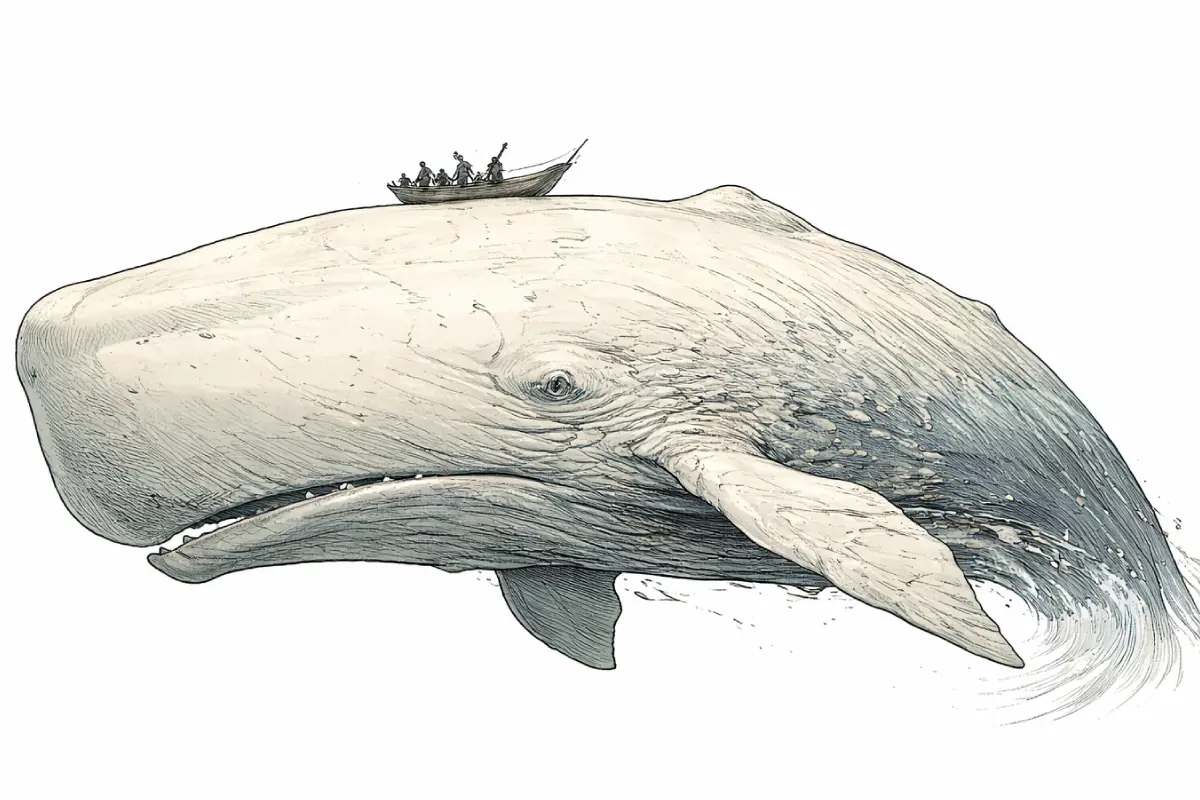
Novel · Obsession, fate, and the whale
Teaching Moby-Dick with Mixed Reading Levels
Ishmael signs onto a whaling voyage and ends up under Captain Ahab, whose hunt for the White Whale is bigger, stranger, and more dangerous than anyone aboard first realizes. This teaching guide shows how to keep a mixed-ability class inside one shared novel conversation with Original and Leveled paths.
How to teach this title in a mixed-ability class
Teach one whole-class unit on Moby-Dick. Differentiate with Original and Leveled tracks so mixed-readiness students share the same story, then anchor discussion in obsession, fate vs free will, knowledge, monomania. Preview free titles first if you are still testing the workflow; unlock full library access with a Classroom License when you are ready.
Why this title works for mixed-ability classes
Moby-Dick by Herman Melville (1851) is commonly placed in the High School (9–12) band with content maturity around 6. The classroom win is keeping one shared conversation about obsession, fate vs free will, knowledge, monomania while adjusting reading load.
Moby-Dick is available in the full library. Try free titles first if needed, then use a Classroom License for whole-class access without student logins.
Original vs Leveled at a glance
Best when students can sustain fuller language and craft analysis.
Best when stamina or decoding load would otherwise stall discussion.
Confirm current metrics before publishing pacing docs. Open reading-level details for the compact FKGL and word-count view, or browse the full Library.
| Choose… | When… |
|---|---|
| Original | Students can sustain denser philosophical prose and you want symbol/craft depth. |
| Leveled | You need broader access to Ahab’s hunt and major turning points for whole-class discussion. |
| Both tracks | Your class has a wide readiness spread and you still want one unit conversation. |
What makes the text demanding
- Length and digression: cetology chapters need a purpose frame or selective path.
- Philosophical density: symbols invite many readings.
- Cast and ship world: roles and ranks need a map.
- Stamina: Leveled path often essential in mixed secondary rooms.
A practical mixed-level week
- Focus 1: Frame obsession as the central problem.
- Focus 2: Select core narrative chapters; treat digressions as purposeful samples.
- Focus 3: Discuss leadership and fate.
- Focus 4: Final claim on monomania and cost.
Assign by story beat or scene cluster, not identical page counts. Hold one discussion set all week so Original and Leveled readers stay aligned.
Discussion prompts that work across versions
- What does Ahab want that killing the whale alone cannot give him?
- Is the novel more about nature, knowledge, leadership, or doom?
- How does Ishmael’s storytelling voice shape what we believe?
- Where do crew members resist—or enable—obsession?
Content and classroom-fit notes
High-school maturity: violence, doom, philosophical intensity. Best with strategic excerpting or strong differentiation.
Study guide and licensing path
Pair reading with a companion study guide when you want ready-made analysis tasks. For whole-library deployment, use the Classroom License: unlock on a teacher device, then share a Student Link or QR so students never need accounts.
FAQ
What grade band fits Moby-Dick best?
Moby-Dick is commonly placed in the High School (9–12) band. Confirm maturity and version metrics in the Library browser before finalizing pacing.
When should teachers choose the Leveled version of Moby-Dick?
You need broader access to Ahab’s hunt and major turning points for whole-class discussion.
Where do I look up FKGL and word counts?
Open the Library browser, find Moby-Dick, and use its title page for reading-level details.