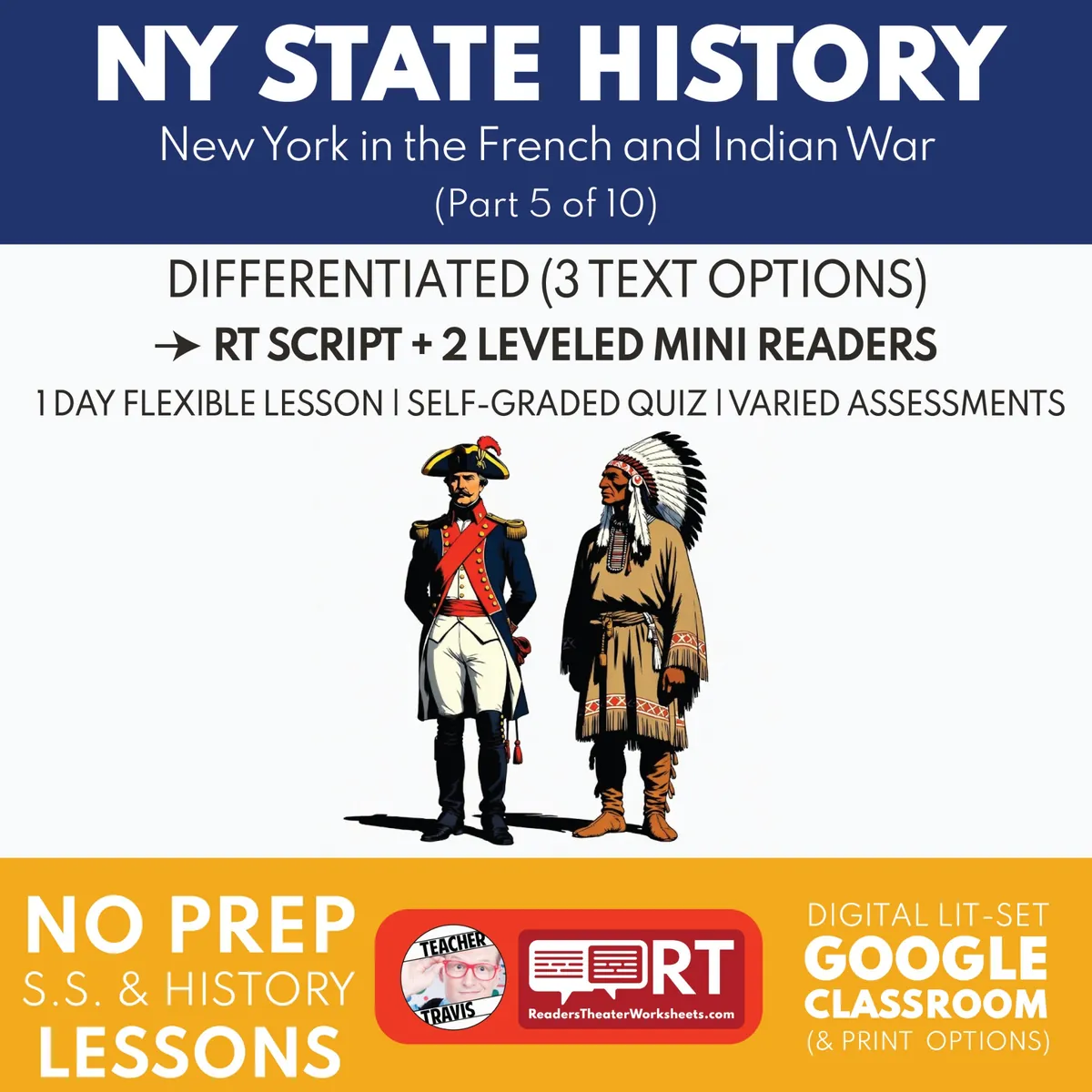
Social studies unit · New York in the French and Indian War
Teaching New York in the French and Indian War with Mixed Reading Levels
Students track forts, alliances, waterways, and empire rivalry to understand New York’s role in the French and Indian War. This teaching guide shows how to keep a mixed-ability class inside one shared social studies unit with Original and Leveled paths.
Classroom solution for mixed reading levels
Teach one whole-class multi-day unit on New York in the French and Indian War. Differentiate reading load with Original and Leveled tracks while everyone stays on the same themes—war, alliances, empire, New York geography. Preview free titles if you are still testing the workflow; unlock full library access with a Classroom License when you are ready.
Why this title works for mixed-ability classes
New York in the French and Indian War by TeacherTravis (2026) is commonly placed in the Upper Elementary (3–5) band with content maturity around 3. The classroom win is keeping one shared conversation about war, alliances, empire, New York geography while adjusting reading load across days.
New York in the French and Indian War is available in the full library. Try free titles first if needed, then use a Classroom License for whole-class access without student logins.
Original vs Leveled at a glance
Best when students can sustain fuller language and craft or content analysis.
Best when stamina or decoding load would otherwise stall discussion.
Version metrics can vary for unit packs and informational titles. Confirm current FKGL and word counts in the Library browser before finalizing pacing docs.
| Choose… | When… |
|---|---|
| Original | Students can handle denser military/political detail for evidence work. |
| Leveled | You need broader access to key battles and alliances for inclusive discussion. |
| Both tracks | Your class has a wide readiness spread and you still want one unit conversation. |
What makes the text demanding
- War complexity: alliances and fronts need a simple visual model.
- Indigenous agency: nations are political actors, not scenery—teach explicitly.
- Cause-to-Revolution link: save for end so war is not only “prequel.”
- Reading stamina: differentiate load; keep shared map talk.
A practical multi-day social studies sequence
- Focus 1: Map strategic waterways and forts.
- Focus 2: Alliance chart.
- Focus 3: Case study of one turning point.
- Focus 4: Cause/effect writing toward later revolution.
Assign by section, poem, tale, or inquiry beat—not identical page counts. Hold one discussion set across the sequence so Original and Leveled readers stay aligned.
Discussion prompts that work across versions
- Why was New York geography strategically important?
- How did alliances shift power?
- What costs of empire appear for different groups?
- How does this conflict set up later revolutionary tensions?
Content and classroom-fit notes
Upper-elementary war history; violence is present at a survey level. Purpose-set conflict study.
Study guide and licensing path
Pair reading with a companion study guide when you want ready-made analysis tasks. For whole-library deployment, use the Classroom License: unlock on a teacher device, then share a Student Link or QR so students never need accounts.
FAQ
What grade band fits New York in the French and Indian War best?
New York in the French and Indian War is commonly placed in the Upper Elementary (3–5) band. Confirm maturity and version metrics in the Library browser before finalizing pacing.
When should teachers choose the Leveled version of New York in the French and Indian War?
You need broader access to key battles and alliances for inclusive discussion.
Where do I look up FKGL and word counts?
Open the Library browser, find New York in the French and Indian War, and use its title page for reading-level details.